Facebook ads audit checklist: 7 checks before testing more creative
This facebook ads audit checklist covers seven structural checks to run before briefing a new creative test. Accounts that skip these checks typically spend two to four test rounds before realizing the creative was never the problem. The seven areas are: measurement accuracy, which metric layer broke, whether frequency explains the drop, whether the ad set exited learning, whether the post-click path still works, whether something changed outside the account, and whether the message has worn out in the market. Work through them in sequence. Stop when you find the failure.
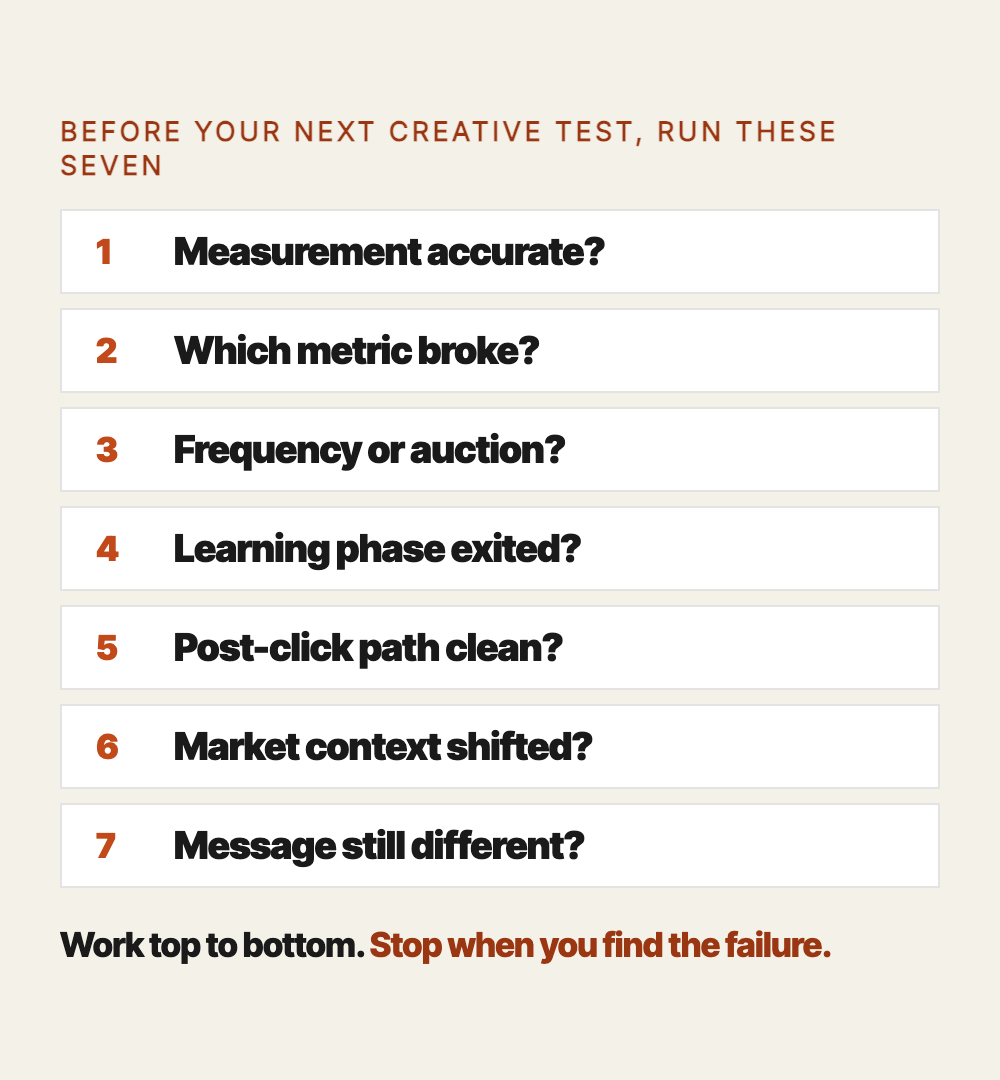
- Check measurement first: if the pixel broke or the attribution window shifted, bad numbers are driving your decisions, not bad creative.
- Read CPM, CTR, and CVR separately: each metric points to a different layer. A CVR drop is a post-click problem, not a creative problem.
- Frequency reveals fatigue: only swap creative when CTR fell alongside rising frequency. High CPM alone points to auction pressure, not worn-out ads.
- Learning phase resets on every major edit: if the ad set never exited learning, the numbers you are judging are noise by design.
- A new creative with the same promise is not actually new: market wear is about the message, not the format. Find a different thing to say before briefing the next test.
1. Is my Facebook ads measurement accurate before I judge performance?
Pull your store or CRM order count for the last 30 days. Pull the conversion number your ad platform reported for the same window. Compare them directly.
Your store records every completed order. The ad platform only records orders it could attribute to a click or view within its attribution window. The attribution window is the number of days the platform looks back from a purchase to find an ad interaction. If that window shortened, or if your tracking pixel broke after a recent site update, the platform reports fewer conversions without any real change in sales.
Confirm three things: the store and platform numbers are reasonably close, the attribution window you are looking at now matches the one you used in the prior period you are comparing against, and the purchase event on your pixel still fires after any site or theme updates. You can check the last one with Meta's Pixel Helper browser extension or the Test Events tool in Events Manager. (Your attribution window is in Ads Manager, under Settings, then Attribution settings.)
According to research from HubSpot and Adverity ("The Waste in Advertising: Stats and Solutions of Misattribution"), industry studies estimate that up to 60% of digital ad spend is effectively wasted. A significant portion of that waste traces directly to measurement errors and misattribution. Confirming the tracking before judging the ad is the first gate.
The sibling article at why-did-my-ads-stop-working covers this check in more depth.
2. Which metric actually changed: CPM, CTR, or CVR?
Read CPM, CTR, and CVR as three separate lines before drawing any conclusion. (CPM and CTR are standard columns in Ads Manager. CVR requires adding a custom metric or using your CRM's post-click data.)
CPM (cost per mille) is what you pay to show your ad to one thousand people. It reflects the auction: how much competition there is for your audience right now. CTR (click-through rate) is the percentage of people who saw the ad and clicked it. It reflects the message: whether it earns attention. CVR (conversion rate) is the percentage of people who clicked and then completed the desired action. It reflects what happens after the click: the offer, the landing page, and the checkout path.
Read them in order. If CTR is fine and CVR fell, the next creative test is wasted spend. The problem is downstream of the ad, not in it. If CPM rose but CTR held, the auction got more expensive and new creative will not fix that either. If CPM is flat and CTR fell, creative is the right suspect.
According to WordStream's Facebook Ads benchmark report (2017), average conversion rates across industries run around 8.78%, with wide variance by vertical. That number is a reference point, not a target. Your own historical baseline matters more. A 30% drop from your own normal is a signal regardless of where you sit relative to the industry average.
3. Is this creative fatigue or is the auction just more expensive?
Frequency is the average number of times one person in your audience has seen your ad. Pull it for the period in question. (Frequency is available as a column in your ad set or ad-level breakdown in Ads Manager.)
Creative fatigue is real, but it is narrower than the term implies. True fatigue shows a specific pattern: frequency climbs, then CTR slides, then cost per click rises. The ad is wearing out on its audience.
What creative fatigue does not look like: CPM spiking while CTR holds. If people are still clicking at the same rate but it costs more to show the ad, the auction changed. Competition for your audience increased, or the audience pool shrank. The Trade Desk's published guidance on frequency states there is no universal cap where fatigue always starts. The right frequency is campaign-specific, found at the point where additional serves stop adding results. That point is different for every account and audience.
This matters because swapping creative addresses fatigue specifically. It does not address auction pressure. If you swap creative and CPM stays high, you have confirmed that this was not a fatigue problem.
4. Did my ad set even have enough time to learn?
Meta uses a learning phase to calibrate each ad set's delivery. During this phase, the system is still figuring out who in your audience responds best and when to show the ad. According to Meta's Business Help Center guidance on the learning phase, an ad set needs roughly 50 optimization events per week to exit the learning phase and move into stable delivery. An optimization event is any purchase, lead form submission, or other conversion action you have told Meta to optimize for.
Judging creative performance inside an unexited learning phase is judging noise. The delivery is inconsistent by design. The numbers you are reading do not reflect a stable audience or a stable cost.
The learning phase also resets. Meta's documentation and agency guidance both treat significant edits as reset triggers: swapping the creative, changing the audience, adjusting the budget by more than roughly 20 percent, or changing the bid strategy. Every time you make one of those changes, the counter starts over. An account that runs frequent creative tests may never fully exit learning on any given ad set, which means the performance signals are never fully reliable.
This is the trap: the desire to test more creative is exactly what prevents a stable read on what any individual creative actually does.
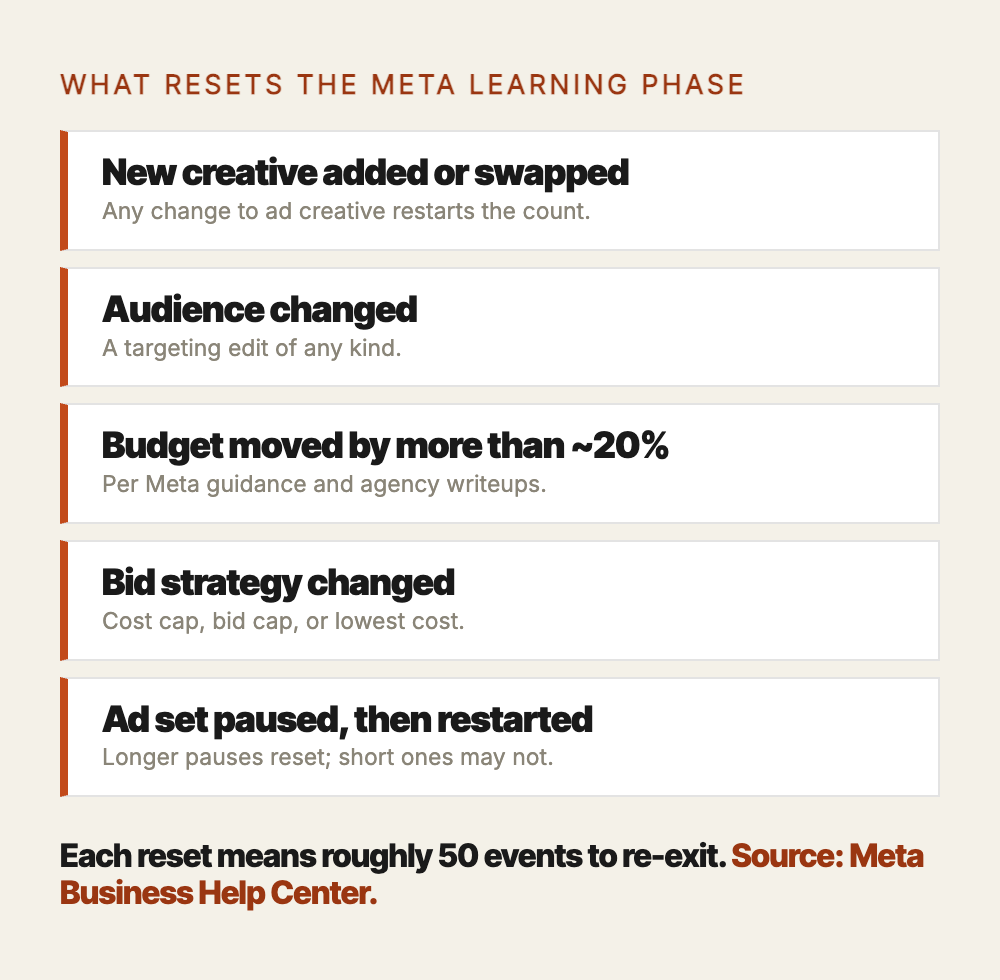
Judging creative performance inside an unexited learning phase is judging noise.
5. Is my landing page working on a real phone?
Open the landing page the ad sends traffic to. Use an actual phone, not a desktop browser, and not Chrome's mobile emulator. Use the connection a buyer in your target market actually uses.
Check every step in the path: the page loads within three seconds, the headline on the page matches the promise in the ad, the price shown matches the price in the ad, every form field works and submits, and the checkout path completes without errors.
Post-click paths degrade silently. A plugin update breaks a form field on mobile. A pricing test leaves a mismatch between what the ad says and what the page shows. A site migration slows page load time significantly. None of these show up in the ad account. From Ads Manager, they all look like the ad stopped working.
NCSolutions research found that the creative itself drives roughly 49% of a campaign's incremental sales, more than targeting or reach. More than half the result lives outside the ad. A post-click path problem quietly destroys that half.
6. What changed outside my ad account that could explain the drop?
Pull up your notes from the same period as the performance drop. Answer these questions directly.
Did a competitor launch a major campaign, a new product, or a significant discount in your category? Did your own product price change, shipping terms change, or delivery time change? Did any external news or event affect demand for your category? Did you change anything on the landing page or in the checkout, even a minor update?
None of these show up as an account change in Ads Manager. All of them can move the numbers. A competitor running a heavy promotion pulls intent buyers toward their offer. A price increase on your side changes the math for buyers who were on the fence. Seasonal demand for your product drops and you have fewer ready buyers in the auction.
The market moves even when the account does not. This is not a platform problem or a creative problem. It is context. A creative test cannot fix a market shift, and running more tests into a market that has moved will produce consistent underperformance. If a market context shift is confirmed, the next move is not a creative test. It is adjusting either the offer, the messaging, or the timing before any new test goes live.
7. Has my Facebook ads message worn out in the market?
Look at what your competitors are saying in their ads. Look at what your own ads have been saying for the last six to twelve months. Ask one question: is the promise your ad makes still something the buyer has not already heard many times?
The clearest source for this check is the Meta Ad Library at facebook.com/ads/library. Search your category to see active ads from any advertiser currently running in your space.
When every competitor in a category makes the same claim, the claim stops registering. This is not because buyers are tired of ads. It is because the specific words and promises no longer carry new information. The buyer has already processed that message and made a decision about it. Seeing it again does not change anything.
This is different from creative fatigue. Fatigue is about frequency with one person. Market wear is about how many times the entire market has heard a category-level promise from all sources combined. A new piece of creative that makes the same promise as the last ten creatives is not actually new. It is the same message in a different format.
The fix is not to produce more creative. It is to find a different thing to say, something the buyer has not already evaluated and moved past.
When is running a new creative actually the right move?
If measurement is clean, the right metric layer broke, frequency explains the fatigue, the ad set has exited learning, the post-click path works, nothing material changed outside the account, and your message is still differentiated: then a creative test is the right move.
A real creative test changes one variable that lets you learn something. Typically that means a different promise, a different opening angle, or a different framing of the outcome the buyer gets. It does not mean a visual re-skin of the same message, a different actor saying the same line, or a new format that carries the same worn claim.
According to the LeadEnforce blog ("Why Most Ad Tests Fail and How to Fix Them"), over 60% of failed ad tests are inconclusive because too many variables were introduced at the same time. Naming what is different about the new creative versus the old, before the brief goes to the creative team, is where that problem gets caught before the spend happens.
Try this on your account right now: open your last three ad briefs and write one sentence describing what each creative promised. Then write one sentence for each new creative you are planning. If any pair of descriptions is interchangeable, you have found where the test will fail before you run it. This exercise works across any category or product type. The test is always whether the new message is actually different from the old one, not just formatted differently.
This checklist covers the diagnostic surface: what each metric signals and what to look for before briefing a creative test. The framework that sits underneath this checklist, covering why messages wear out and how to read demand, positioning, offer, and conversion path together, is what the Hub teaches. A 7-day free trial gives you full access to that framework. Join at vicontent.com/hub.
The checklist has a layer underneath it. The Hub teaches that layer.
A 7-day free trial shows why a message wears out and what to realign, not just which box you checked.
Start your free trial →Frequently asked questions
How long should I wait before judging a new ad?
Wait until the ad set exits the learning phase. According to Meta's Business Help Center guidance, that means roughly 50 optimization events per week. In a healthy account with sufficient budget, that can happen within the first week. In a lower-volume account, it may take two to three weeks. Reading results before the learning phase ends gives you inconsistent delivery and inflated or deflated early numbers. A practical floor: do not make kill or scale decisions on an ad that has fewer than 50 relevant conversions attributed to it at the ad set level.
How many creatives should I test at a time?
Fewer than most people run. The more active creatives you have in a single ad set, the less delivery each one receives, and the longer it takes any single creative to accumulate enough data to read. Running three to five creatives in an ad set generally produces faster learning than running ten to fifteen. If you need to test more volume, use multiple ad sets rather than loading more creatives into one. The goal is enough data per creative to reach a clear read, not maximum creative count.
If CPM went up, is that always a problem?
Not always. CPM (cost per thousand impressions) goes up when competition for your audience increases or when the audience pool tightens. If your CTR held and CVR held, a higher CPM means you are paying more to reach the same quality of buyer. Whether that is a problem depends on whether the final cost per result still meets your target. If CPM rose and CTR also fell, that combination is more concerning because both the cost and the response rate moved against you.
When does swapping creative actually fix the problem?
When the metric that broke was CTR and frequency is high. That is the cleanest case for a creative test: the ad wore out on the audience, people stopped clicking, and new creative re-engages them. Outside that specific pattern, creative swaps address a symptom rather than the cause. Check through this list before briefing the test.
Does running more creative tests protect against performance drops?
Running more tests faster does not protect against structural problems, and it actively works against learning if the testing frequency is high enough to keep ad sets in the learning phase. The accounts that navigate performance drops most quickly tend to have fewer, cleaner tests running at once. They can read each test clearly, identify what moved, and act on the signal. An account running many simultaneous tests in overlapping learning phases produces a lot of activity with little readable signal.
Related reading: Why did my ads stop working? · What the Ad Marketing Hub teaches